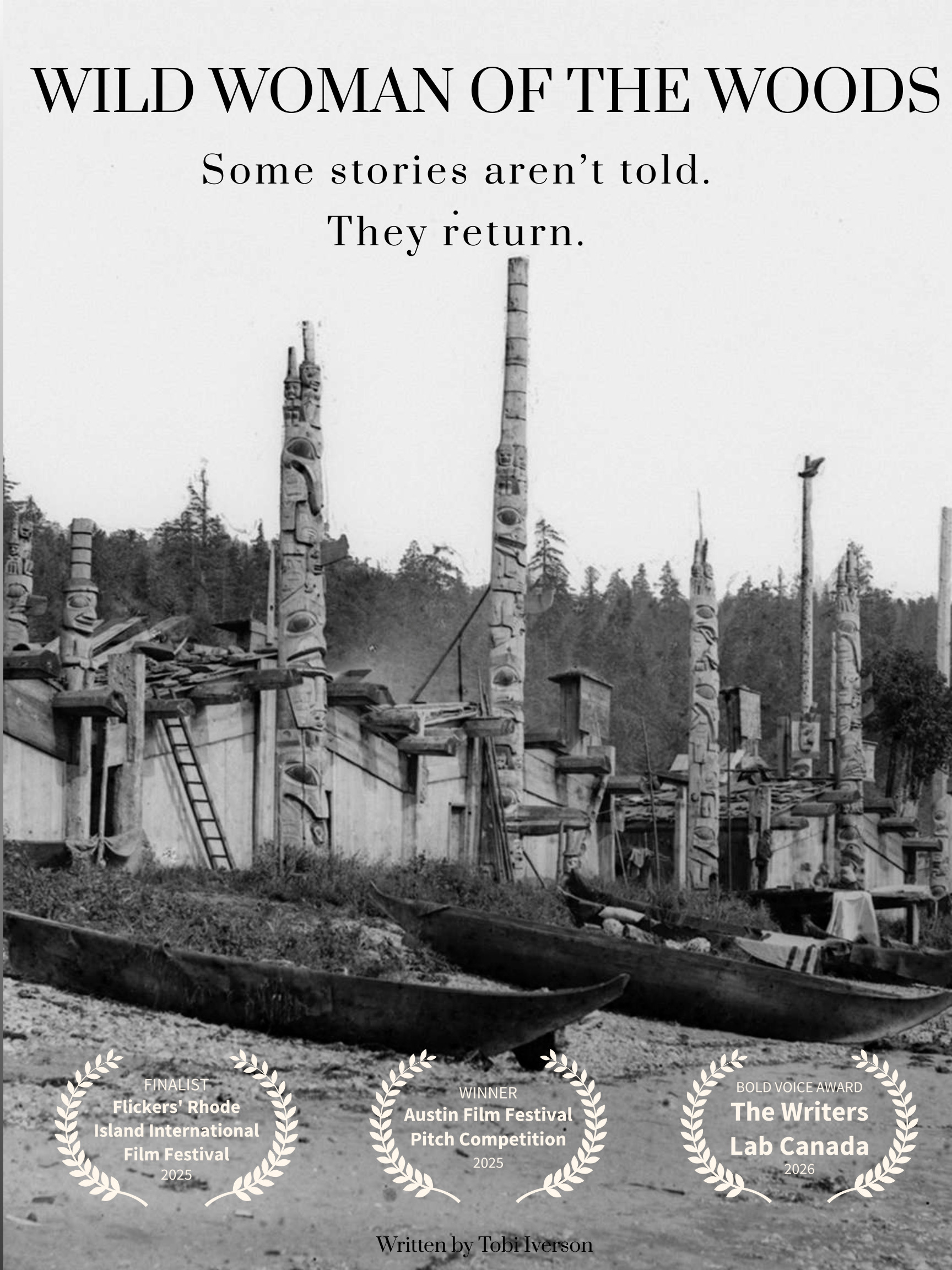
Tobi Iverson writes Northwest Coast historical epics.
Open ocean crossed by canoe. Formline carved into everything a person owned.
People who have lived with this land for thousands of years. Not on it.
She is the great-great-granddaughter of Arthur Wellington Clah, who kept the only known Indigenous diary of the nineteenth-century Pacific Northwest Coast — sixty-nine volumes, fifty years, 1859 to 1909. She writes from his journals, from family history, from anthropology, and from years spent with the material culture of the coast — in archives, in museums, and with the people who carry it now.
She writes history as fiction.
The written histories are often incomplete, contradictory, and shaped by the perspectives of the people who recorded them. She isn't correcting them. She isn't a documentarian. She tells this history through real people, imagined the way she sees them. That's more interesting to write, and she thinks it's more honest — she isn't a historian, and everything she reimagines sits on the work of the academics who kept that knowledge and researched it.
Where the history matters, she keeps it accurate. But the story isn't the record. It's the human part. Emotion, and the choices people made under impossible pressure.
She writes about people whose voices have been muffled or distorted by those who benefit from silence. They are defiant. Angry. Left to work out what to do with grief they inherited. Heal it, or carry it and keep going.
She always knew she was Alaska Native, and she knew her tribe's name — mispronounced for years by people who meant well. There wasn't much a family could find then. What they could, they gave her. They were proud of it before she was.
She did not grow up in the culture she writes from. No reservation. No art on the walls. For a long time she wished she weren't Native at all — it wasn't respected or desirable, and she carried it as a liability.
She went looking anyway. She couldn't not do it. She tried.
She joined the cultural dance group. She tried her hand at cedar bark harvesting, to weave hats and baskets. She was a terrible weaver. She couldn't sew a button on her blanket. Her drumming was always enthusiastically off beat. So she stuck with dreaming, reading, and writing.
She is drawn to the Northwest Coast — its stories, its art, its myths — the way some people are drawn to music or mathematics.
The elders and community members she found as a young woman changed her. People who knew her grandparents. Who carried the culture with such pride and certainty — this is who we are, no matter what's happened. She read about the culture. But through them, she felt it.
Long before film, she led federal partnership programs across the Northwest, in formal relationship with tribal nations across four states. She worked in government, in tribes, in real estate and small business, and learned the craft on her own time.
She tells these stories not to claim them alone, but to carry them, alongside the community still holding this world today.